

PlayStation 4 Firmware 12.52 Exploit Released – Mod your console and play all the games
25th November 2025
262GB of Windows 95 and 98 games to play for free – eXoWin9x
30th December 2025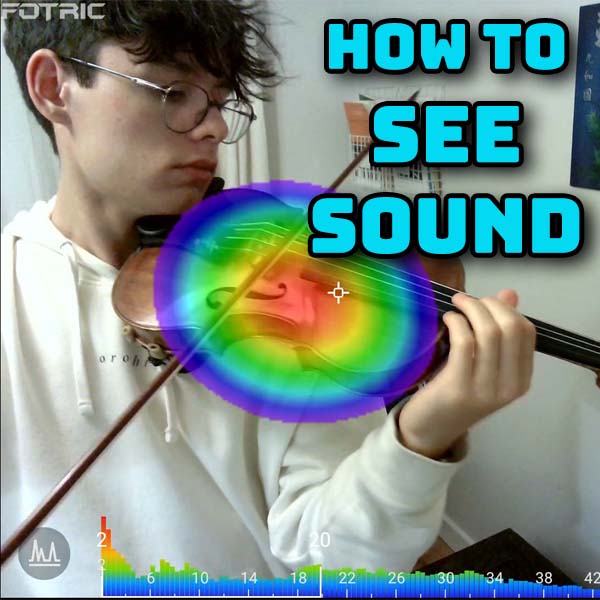
How to see sound with an acoustic camera – Fotric TD2Geek Acoustic Camera
We’re all used to using digital camera to take photos and videos of what we can see. These are visible light sensors. If you’ve been watching my channel you’ll also have seen me using some thermal cameras to see heat. These work in the infra red end of the light spectrum. But one thing I hadn’t come across before was the sound or acoustic camera.
This is a device that actually lets you see sound.
So in this video we’ll be taking a look at the Fotric TD2 Geek Acoustic camera to see what it is and what you can do with it.
So let’s first have a think about what it’s doing.
What Is Sound?
First off we need to have a look at what sound is.
When an object vibrates it uses this vibration energy to push and pull the air particles around it. These particles then push and pull the air particles around them and so the vibration energy gets transferred through the air in the form of a sound wave with the molecules going through compression and rarefaction. If you can remember back to physics this is called a longitudinal wave. These waves travel at a set velocity according to whatever medium they are passing through. For air this is 340m/s at sea level.
When the wave carrying the vibration energy hits your ear or a microphone it transfers some of the energy into vibrating either your ear drum or the diaphragm which can then be detected.
How Does an Acoustic Camera Work?
An acoustic camera uses the fact that these sound waves travel at a specific speed from the sound source to the sound detector.
Think about a firework exploding. If you’re standing right next to it, you hear it almost instantly. If you’re standing far away you’ll see the explosion but the sound will take a short while to travel to you.
This difference is distance causes a time delay between the two detectors.
If you now think about your ears. They are a short distance apart. Any sound to either side of you will take longer to reach one ear than the other. This is how we detect the direction of sounds.
The acoustic camera is doing the same, just a whole lot better.
Sound Direction Experiment
We can actually see this happening by setting up a small test rig.
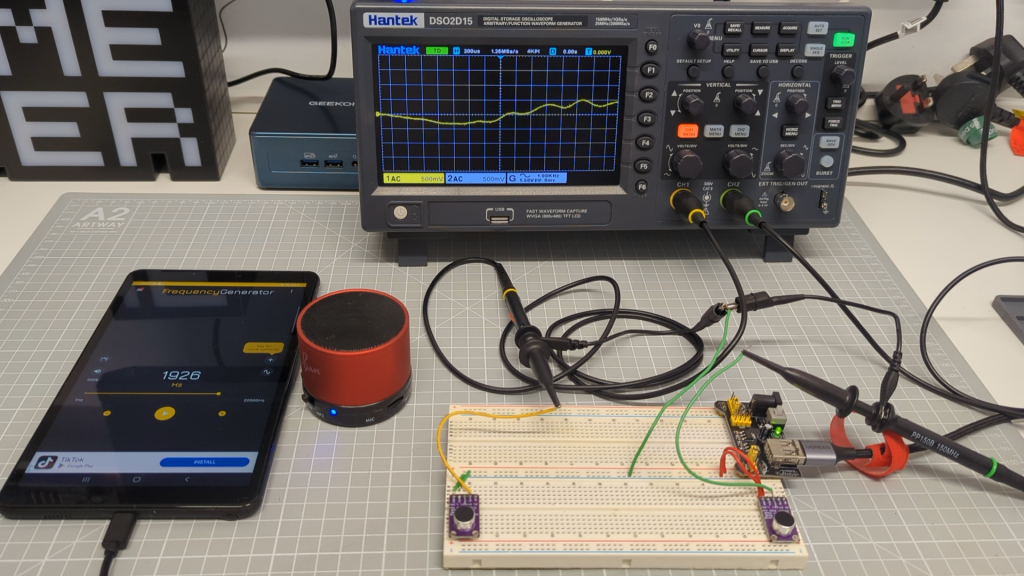
Our speaker is acting as a single point sound source and you can see on the oscilloscope that we’ve got the waveforms from each microphone.
As I line the speaker up in the centre of the two microphones you can see the traces are exactly in phase. This is because the distances from the speaker to each microphone is the same so the sound waves reach the sensors at exactly the same time.
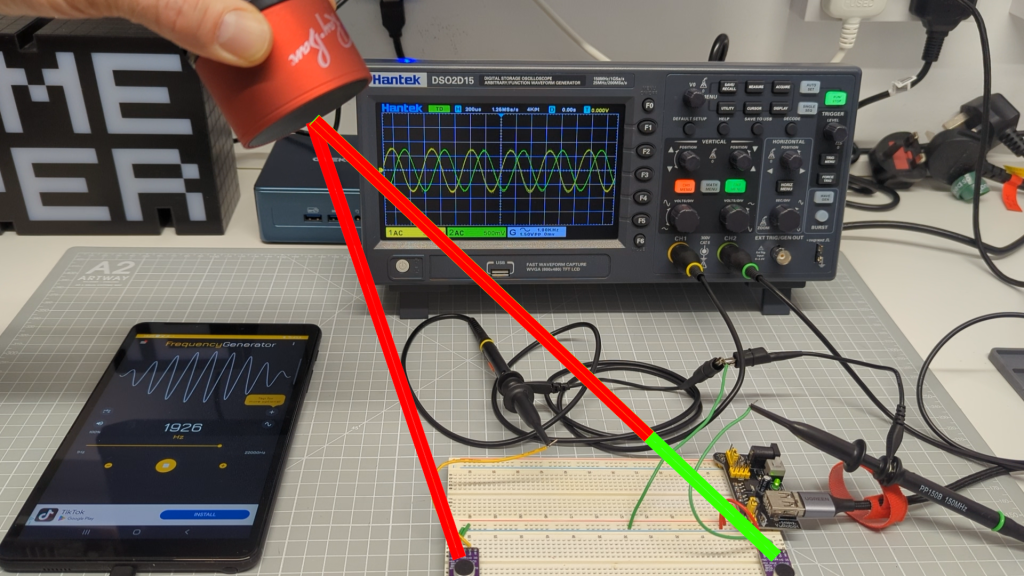
If I now move the speaker to the left you can see that the green trace starts to move to the right of the yellow trace. This shows that it is taking longer to reach the microphone due to the longer distance the sound wave has to travel.
If I now move the speaker over to the right we can see the traces coming together and then the green trace moving to the left of the yellow trace. This shows the sound wave is reaching the right speaker sooner than the left, again due to the relative distances the sound wave has to travel.
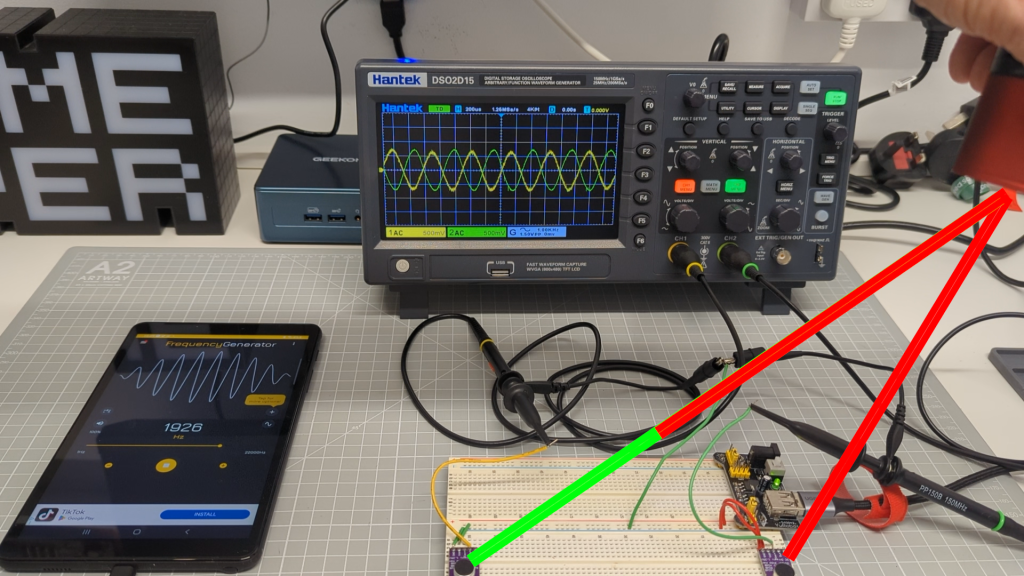
So by looking at the alignment of the two microphone signals we can calculate what’s know as a phase difference which gives us an idea of which direction the sound is coming from. With just two microphones we can see, in this set up, left to right direction, but if I move the speaker into and out of the frame the traces show no change, again because the relative distances to the microphones doesn’t change.
The Fotric sensor takes this phase difference comparison to another level. It uses 64 microphones which are the smaller holes on the front of the sensor. The larger hole is a normal light camera which it uses to show the scene we are looking at.
The data from each microphone is then processed to separate individual sounds and then these sounds are compared across the whole microphone array. The process is a lot more complicated than our simple phase difference experiment but based on the same basic principals. This lets the sound camera calculate the direction of each sound precisely so that it can build up a picture of where, how loud and what frequencies it can hear.
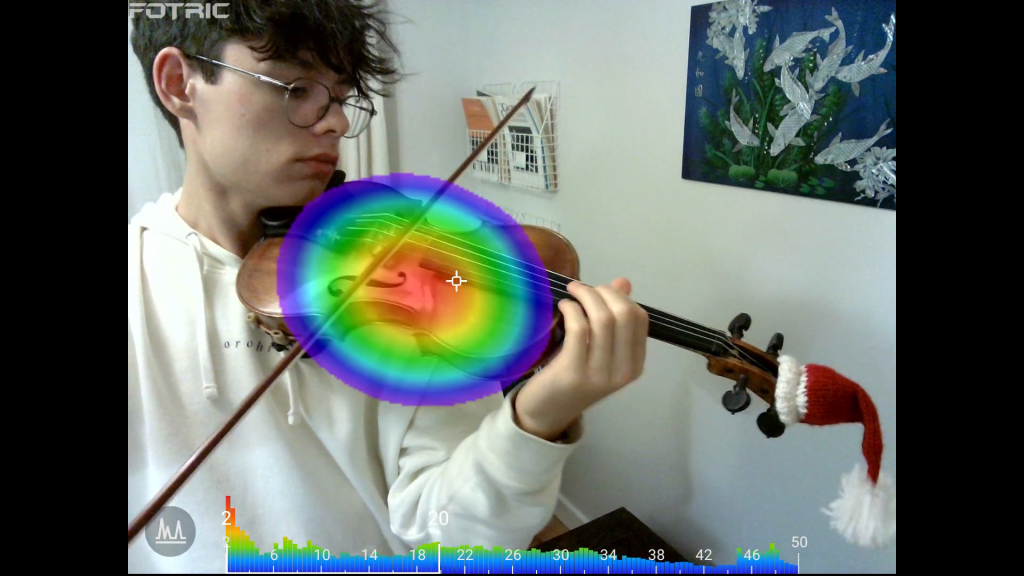
This sound map is then superimposed on the light camera image to let us visualise the sound information on top of what we can actually see with our eyes.
Common Uses for an Acoustic Camera
Acoustic cameras are widely used across industries for their ability to visualize sound sources. Some of the most common applications include:
Leak Detection
Example: Detecting compressed air leaks in a factory’s pneumatic system to reduce energy waste and improve efficiency.
Mechanical Diagnostics
Example: Pinpointing abnormal bearing noise in a conveyor motor before it leads to costly downtime.
Electrical Inspections
Example: Identifying partial discharge in high-voltage transformers at a power substation to prevent equipment failure.
Environmental Noise Analysis
Example: Mapping traffic noise levels near a residential area to support urban planning and noise mitigation strategies.
Product Testing
Example: Measuring sound emissions from a new electric vehicle prototype to ensure compliance with regulatory standards.
Research and Development
Example: Studying acoustic patterns in aerospace components during wind tunnel testing to optimize design for noise reduction.